








ATHENA European University
The Universidade de Vigo is part of the European University ATHENA, an alliance of ten institutions of higher education and research
The European Universities Initiative is a flagship project of the EU in the field of higher education and research, aiming to promote the internationalisation of European universities and to make them more competitive and more inclusive.
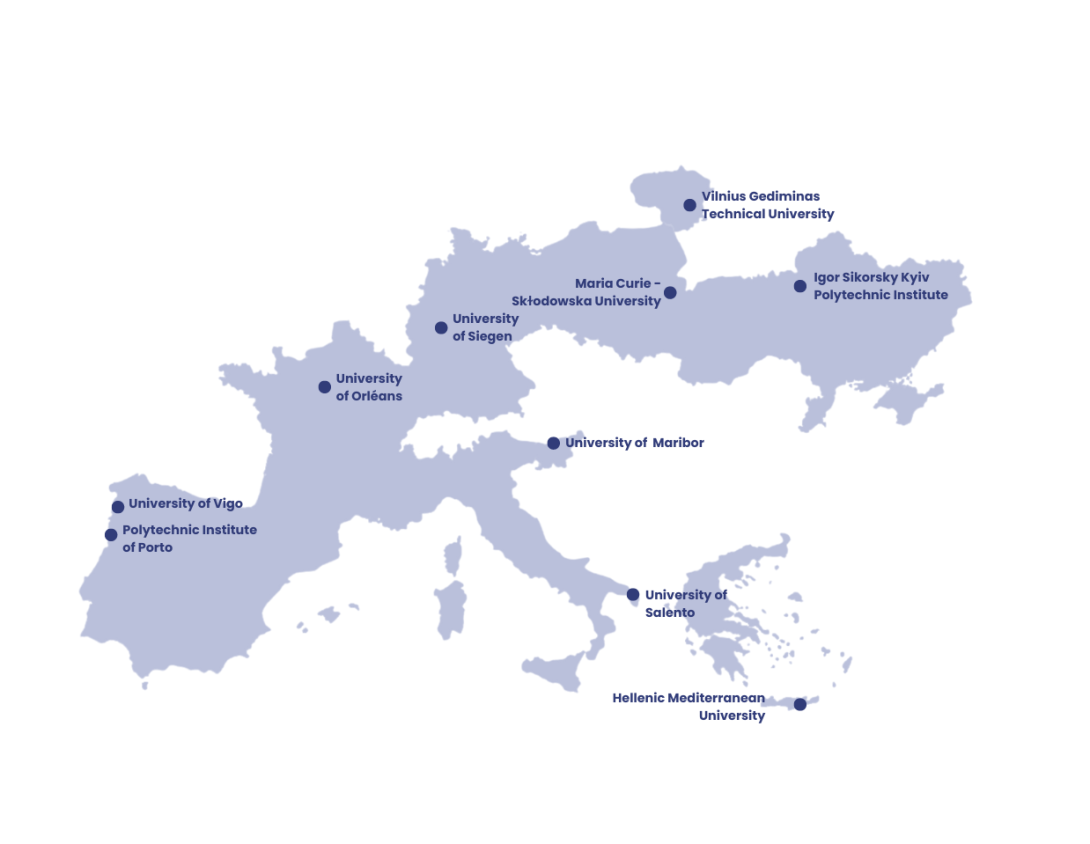
The Advanced Technology Higher Education Network Alliance (ATHENA) is one of the pilot projects of European Universities selected by the European Commission in 2020. In addition to the Universidade de Vigo, the following institutions also take part in the alliance:
- Univerza v Mariboru-University of Maribor (Slovenia)
- Instituto Politécnico do Porto-Polytechnic Institute of Porto (Portugal)
- Université d'Orléans-University of Orléans (France)
- Universität Siegen-University of Siegen (Alemaña)
- Vilnius Tech (Lithuania)
- Ελληνικό Μεσογειακό Πανεπιστήμιο-Hellenic Mediterranean University (Greece)
- Uniwersytet Marii Curie-Skłodowskiej w Lublinie-Maria Curie-Skłodowska University in Lublin (Poland)
- Università del Salento (Italy)
- Igor Sikorsky Kyiv Polytechnic Institute (Ucrania)
Associated partners:
- Fachhochschule Kärtnen (Austria)
- Націона́льний університе́т «Льві́вська політе́хніка»-Universidad Nacional Politécnica de Lviv (Ucrania)
Networks:
Focusing on the digital transformation of societies, the European University ATHENA aims to create internationalised programs, encourage international mobility among the largest number of students, promote joint research and development projects and open up new European perspectives, not only to the more than 160,000 students and 15,000 staff of the alliance, but also to local communities and partners.
What is a European University?
Se trata de alianzas transnacionales con el objetivo de liderar el camino a las universidades del futuro, promoviendo los valores y la identidad europeos y revolucionando la calidad y la competitividad de la educación superior europea.
Las alianzas abarcan socios de todo tipo de instituciones de educación superior de diferentes áreas geográficas en Europa, para ofrecer currículos centrados en cada estudiante e impartidos conjuntamente en campus interuniversitarios, donde disponen de diferentes opciones de movilidad. Todo ello, desde un enfoque de cooperación interdisciplinar para abordar los problemas de la Europa de hoy en día
Al colaborar con unos 1300 socios, como organizaciones no gubernamentales (ONG), empresas, ciudades o autoridades locales y regionales, las Universidades Europeas pueden aumentar sustancialmente la calidad y el alcance de la educación superior en Europa.