



Multilingualism
The Linguistic Internationalization Plan responds to the decision to follow a strategy to promote multilingualism, associated with the strategic goal of achieving a more international university.
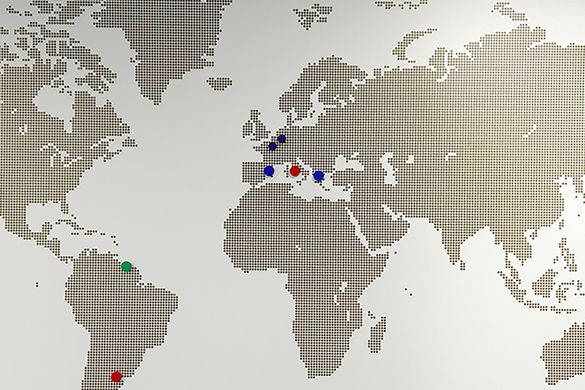
For this reason, one of the main objectives of the Universidade de Vigo is the commitment to enhance collaborations with Portuguese-speaking countries thanks to the historical relations between Galicia and Portugal and the intercontinental territories with the official Portuguese language. In this sense, participation in international fairs in these countries and the signing of collaboration agreements with countries with a migratory tradition are promoted to attract international students.
Linguistic Internationalisation Plan
Structure
The common objective of the Linguistic Internationalization Plan is to promote competence in foreign languages of the university community as a fundamental element of the European higher education policy. For this, the plan is structured in such a way that:
- It takes into account the current situation of our institution regarding competence in foreign languages and the needs of the members of the university community.
- Promote proactive success in multilingualism and institutional multilingualism.
- Guarantee the access to learning foreign languages, in collaboration with the Language Center.
- Encourage native speakers of other languages to use their native language, without prejudice to the knowledge of the official languages of Galicia and the UVigo.
- Promote linguistic and cultural diversity and awareness of the university community.
- Facilitate mobility of students, teaching and research staff, and administration and service staff.
- Encourage lifelong learning of foreign languages.
Objectives
According to the Nancy Declaration, published by the Council of Europe in 2006, universities must develop appropriate policies to allow all European university graduates to:
- Be able to communicate at least in two languages in addition to their own languages
- Be able to improve the linguistic knowledge
- Be confident and instructed in how to learn a new language when needed or occasiond
- Gain first-hand experience working and learning in our countries, and collaborating with them
- Become familiar with other cultures and acquire intercultural skills
To be able to achieve the desired results and the correct implementation of the Linguistic Internationalization Plan, the following tools are available:
Language center
The Language Center was born in 2004 to promote and develop training activities in modern languages, attending to the linguistic needs of the university community and its surroundings. After more than 15 years of experience, we are a benchmark in language teaching and level accreditation, working in collaboration with the most recognized accreditation entities: ACLES, Cambridge Assessment English, Instituto Cervantes, ETS TOEFL, etc.
The main activity of the Language Center is the specific training of the university community to contribute to the quality of teaching and research and the internationalization of the Universidade de Vigo.
We invite you to learn more about the Language Center and its training offer:
On the other hand, the Languages Area of the UVigo, through the Language Center of the Universidade de Vigo Foundation, has as its main mission to implement the linguistic internationalization policy of the university, through or promoting the necessary actions to improve competence in foreign languages. members of the university community, as well as to develop competencies in the university's own languages among us and our international visitors.
Teaching in English
There are subjects, both undergraduate and master's degrees, that are taught in English. Check the academic year here:
- Bachelors
In your own section of undergraduate and master's studies you can see in detail the subjects of each degree.
English Friendly subjects
The university also has an English Friendly subject program, which is taught in the official UVigo degrees in Spanish and/or Galician, but when its teachers make the following commitments:
- Indicate the English Friendly character in the teaching guide of the subject
- Translate the teaching guide into English
- Provide materials and references bibliographies for the follow-up of the subject in English, if requested by an international student
- Attend to tutorials in English, if requested or/ to international student
- Design and carry out tests and assessments in English, if requested by an international student
Emilab
EMI (English Medium Instruction) is being adopted by a growing number of universities around the world, including the UVigo. To help with the challenge of teaching in English, we make available to the EMILAB university community, an online repository with resources for teachers who teach in English, which will be permanently updated. It will also be useful for writing scientific articles in English and effective interaction in academic and scientific settings.
HELA, Higher Education Lecturing Accreditation
HELA (Higher Education Lecturing Accreditation) is a test designed at the Universidade de Vigo that guarantees that teachers have the linguistic skills necessary to successfully teach foreign languages. Assesses language proficiency, fluency, communication skills, oral presentation and interaction skills with students.
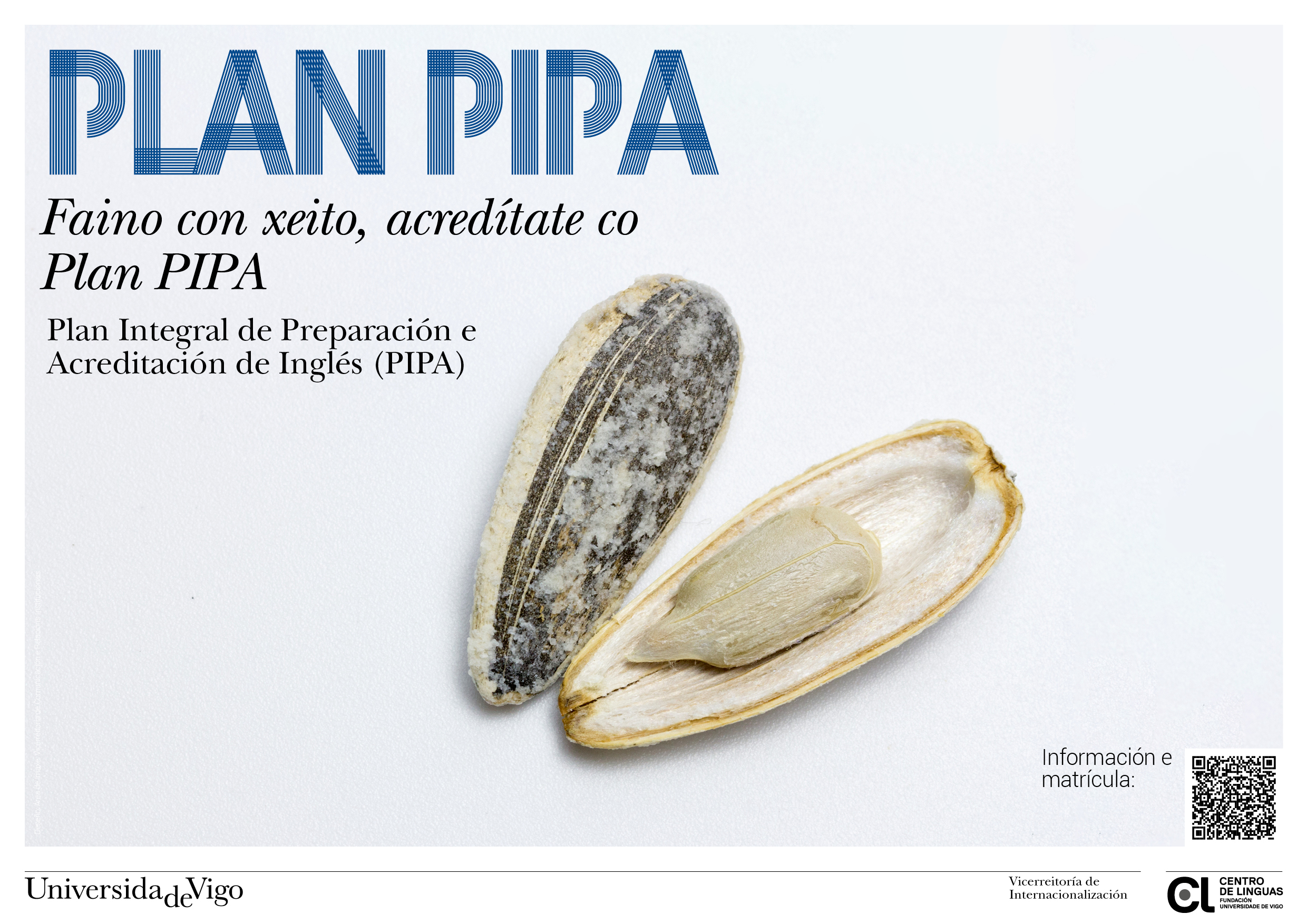
Comprehensive English Preparation and Accreditation Plan (PIPA)
The Universidade de Vigo, through the office of the Vice Rector for Internationalisation, has recently launched the Comprehensive English Preparation and Accreditation Plan (PIPA) to enable first-year undergraduate students to obtain free accreditation at the B1 level in English.
Fase 1: Proba de nivel
O estudantado que curse 1.º de grao (por primeira vez) durante o vixente curso, accede a Moovi. Aí atopará unha proba de nivel que poderá realizar nun só intento. As datas dispoñibles da proba atópanse na mesma plataforma Moovi.
Fase 2: Curso de preparación do exame CertAcles de acreditación de nivel B1
Se ao realizar a proba de nivel a persoa é seleccionada, esta poderá cursar unha formación semipresencial de preparación do exame CertAcles de acreditación de nivel B1 gratuitamente. É un curso de 10 horas (8 horas de traballo autónomo que poderá facer no horario que máis lle conveña a través da plataforma LMS Moovi e 2 horas de clase presencial que terán lugar nos tres campus da Universidade de Vigo en quendas de mañá e tarde. Este curso permitirá familiarizarse coas distintas probas do exame oficial que terá lugar o 16 de maio de 2024.
Fase 3: Exame CertAcles de acreditación de nivel B1 (16 de maio de 2024)
Se o/a estudante asiste ao 85% do curso de preparación, poderá facer o exame CertAcles de acreditación de nivel B1 gratuitamente. As acreditacións de nivel CertAcles teñen validez en todo o Espazo Europeo de Educación Superior, o que significa que lle van aceptar en calquera universidade europea. Para máis información sobre os exames CertAcles (descricións, modelos, convocatorias, etc.) cómpre premer na páxina Exames CertAcles.
Resultados da 1ª convocatoria 2024
O estudantado de 1.º de grao da Universidade de Vigo que, segundo o resultado da proba de nivel de inglés que fixo a través da plataforma LMS Moovi, está en disposición de presentarse a un exame CertAcles de acreditación de nivel B1 é:
Procedemento de inscrición para as persoas seleccionadas e en lista de agarda:
Se foches seleccionado/a ou apareces na lista de agarda como persoa beneficiaria do plan PIPA, rexístrate aquí (se é a primeira vez) ou accede empregando o teu nome de usuario e contrasinal para, a seguir, inscribirte no Obradoiro de preparación do exame CertAcles de nivel B1. Como este plan está financiado ao 100% pola Vicerreitoría de Internacionalización, a taxa de matrícula será de 0 euros.
O prazo de inscrición remata o día 6 de abril de 2024, ás 23.59 h
Lembra que para poder manter a condición de persoa beneficiaria do plan PIPA terás que asistir ao 85 % das sesións do obradoiro e presentarte ao exame oficial de CertAcles o día 16 de maio de 2024.
Some other information:
- Documento Marco de Política Lingüística para la Internacionalización del Sistema Universitario Español, aprobado por los rectores de las 76 universidades de la CRUE el 9 de mayo de 2017
- Táboas de ACLES
- Táboas da Mesas Lingüísticas de la CRUE
Further information:
Vice-Rectorate for Internationalisation
Edificio Miralles
As Lagoas, Marcosende
36310 Vigo
+34 986 813 587
internacional@uvigo.gal